
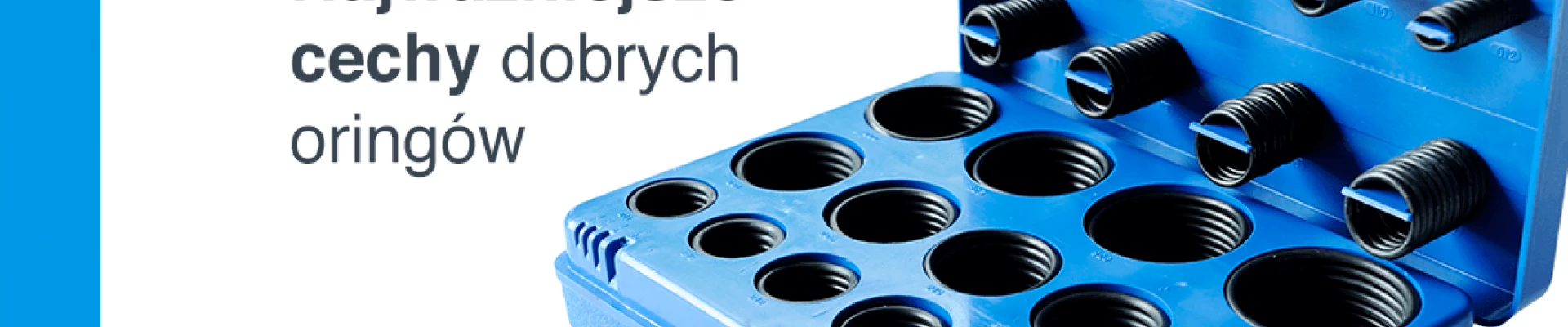
Key Characteristics of High-Quality O-Rings
O-rings are among the simplest yet most widely used sealing elements in modern engineering. Their simple design, reliability, ease of installation, and relatively low cost make them one of the most common types of seals used in industry. O-rings are widely applied in hydraulics, pneumatics, automotive systems, and many other technical fields.
What Is an O-Ring?
An O-ring is a sealing ring with a torus shape – in simpler terms, a closed ring with a circular cross-section. O-rings are typically manufactured from elastomer materials, which provide flexibility and allow the seal to deform when compressed.
During operation, the O-ring is compressed between two surfaces. This deformation creates the sealing force that prevents leakage. Thanks to this principle, O-rings can be used both in:
- static sealing applications,
- dynamic applications such as hydraulic pistons.
O-Ring Dimensions and Identification
Standard O-ring sizes are defined by two main parameters:
- d1 – inside diameter,
- d2 – cross-section diameter.
These two dimensions uniquely determine the size of the sealing ring. High-quality O-rings are typically manufactured according to the DIN 3771 standard, which defines dimensional tolerances and quality requirements for sealing rings.
Manufacturing Precision
One of the most important characteristics of high-quality O-rings is manufacturing precision. Accurate dimensions and consistent material structure directly influence sealing performance, durability, and resistance to deformation.
Precise manufacturing allows O-rings to be used in a wide range of applications, from simple technical devices to demanding hydraulic and industrial systems.
No Surface Defects
Production standards require O-rings to be free from surface defects such as:
- cracks,
- air bubbles,
- holes or material voids.
During molding, small flash lines can appear where the mold halves meet. Modern production processes remove this excess material, often using cryogenic deflashing. This process improves sealing performance and durability.
Manufacturing according to DIN 3771 allows only minimal geometric deviations.
O-Ring Materials
The elastomer material used for O-rings must be selected according to operating conditions and the working medium. The material determines chemical resistance, temperature limits, and overall durability of the seal.
Commonly used O-ring materials include:
- NBR – nitrile rubber,
- FPM / FKM – fluoroelastomer (commonly known as Viton),
- EPDM,
- CR – chloroprene rubber,
- VMQ – silicone rubber.
Typical Temperature Ranges
| Material | Temperature Range |
|---|---|
| NBR | -30°C to +100°C |
| FPM (FKM) | -20°C to +200°C |
| EPDM | -50°C to +140°C |
| CR | -35°C to +100°C |
| VMQ | -60°C to +200°C |
Selecting the correct material is essential to ensure long service life and proper sealing performance under specific operating conditions.
Why O-Rings Are So Popular
O-rings remain one of the most widely used sealing solutions thanks to several important advantages:
- simple design,
- high sealing efficiency,
- easy installation,
- wide availability of sizes,
- cost-effective solution.
Because of these advantages, O-rings are used in many areas – from household equipment and automotive components to advanced hydraulic and industrial machinery.
Simple solutions often prove to be the best ones. O-rings are a perfect example: combining functionality, durability, and affordability, they remain a fundamental sealing element across many technical applications.